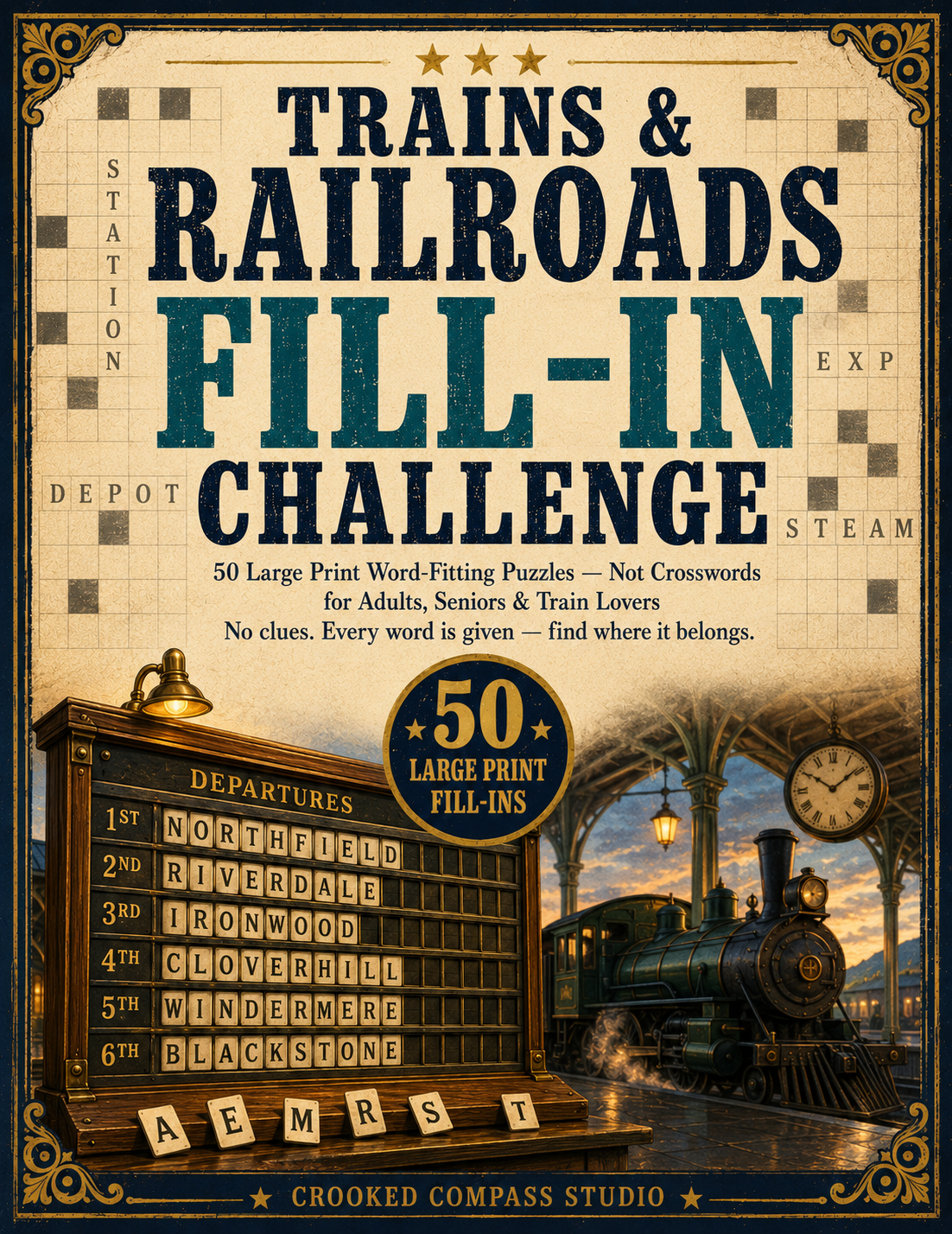
No clues. Every word you need is printed below the grid, grouped by length. One is already in place. The rest is a matter of working out where each one belongs.
Every word on the list has exactly one home.
If you have never solved one, it takes about a minute to learn. Many people find it gentler than a crossword — there is nothing to know, only somewhere to put it.
Below every grid is the full list of answers, grouped by how many letters each one has. Nothing is hidden and nothing has to be guessed from a clue.
If there is one eleven-letter space and one eleven-letter word, it can go nowhere else. Write it in, cross it off the list, and the crossings begin to fall.
Every word you place drops letters into the spaces that cross it. A five-letter space that now begins with a T narrows the list at once.
Three- and four-letter words are the last to fall, not the first — there are simply too many of them until the crossings have decided the rest.
Every word in every grid belongs to the book's subject.
No clue column means the grid gets the whole page.
Each grid checked by computer: exactly one way to fit the list.
One answer is already placed in every puzzle.
Each volume stands alone. New subjects added regularly.
Fifty grids drawn from the golden age of rail — locomotives and cabooses, roundhouses and semaphores, the crews who ran the trains and the towns that grew around the depot. Between twenty-six and thirty words in every puzzle.